Knee pain after your knee hits the dashboard: questions worth asking
Published by Portsmouth Accident & Injury Center.
Dashboard contact can be followed by knee pain, bruising, swelling, stiffness, or difficulty walking. Where the knee made contact does not identify the injured structure. Note swelling, motion, weight-bearing, and stability — and seek prompt medical care for deformity, inability to bear weight, major swelling, a cold or discoloured foot, severe pain, or symptoms that are getting rapidly worse.
The knee leaves a clean clue: a tender spot or bruise where it met the dash. It is tempting to treat that clue as the complete answer.
But a knee is a joint, and a joint has more going on than the spot that got hit. The direction of force, foot position, hip position, rotation, and what happened afterward can all matter. A careful evaluation begins with the contact point and keeps asking.
What should you write down in the first hours?
Worth noting:
- Which knee made contact
- The exact location: kneecap, inside, outside, below, or above
- Whether a bruise, scrape, or swelling appeared
- Whether you can fully straighten and bend the knee
- Whether standing and walking feel stable
- Any clicking, catching, locking, numbness, or tingling
- Whether the hip, ankle, or low back also changed
Photograph visible changes without filters and store the image securely. Do not repeatedly squat, twist, or kneel to produce a more dramatic record.
Which knee symptoms need prompt medical attention?
A dashboard mark does not rule out circulation, nerve, fracture(opens in a new tab), or significant joint concerns. Use the right medical setting when the symptoms call for it.
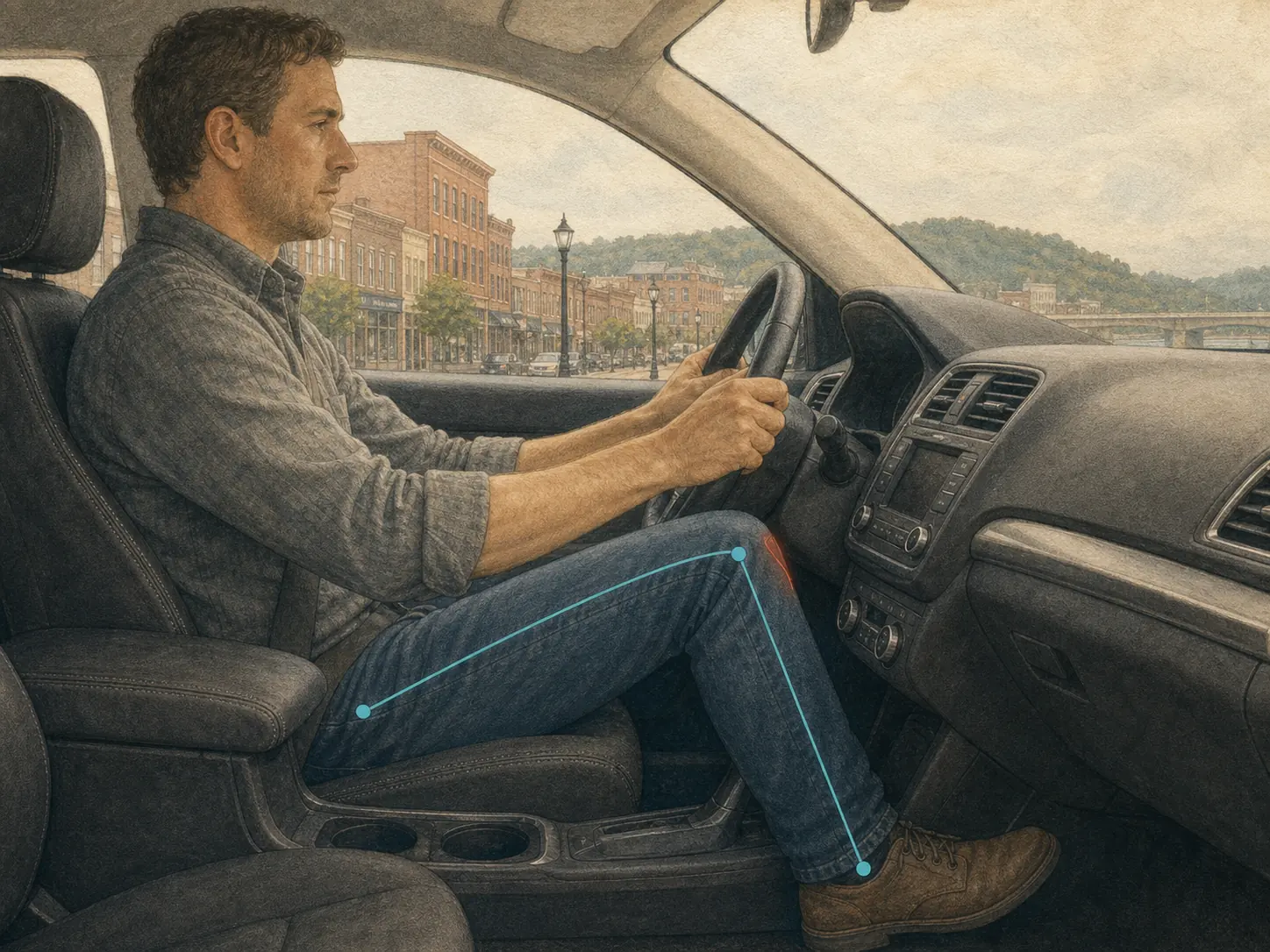
Why ask about the hip when the knee hurts?
The thigh connects the knee to the hip, and a force through a bent knee can make the hip part of the clinical question. An altered walk may also expose hip or low-back symptoms later.
Tell the evaluator whether the hip hurts, whether the leg feels shorter or positioned differently, and whether getting in and out of the car is difficult. Do not assume the knee bruise explains every symptom above it.
Our knee and hip pain page describes how these complaints can overlap while preserving the referral-first boundary.
Does a bruise tell you whether anything is torn?
No. A bruise shows bleeding into tissue near the skin. It does not diagnose a ligament, tendon, cartilage, bone, or joint injury — and the range of things that can go wrong in a knee(opens in a new tab) is wide. The absence of a bruise does not prove the joint is uninjured either.
Examination may include observation, tenderness, motion, strength, weight-bearing, stability checks when appropriate, and a comparison with the other side. Imaging decisions depend on the findings and medical judgement.
What everyday movements make a useful baseline?
Choose safe, ordinary tasks rather than athletic tests:
- Rising from a standard chair
- Walking from the house to the car
- Using one familiar flight of stairs
- Bending the knee enough to put on a shoe
- Getting into and out of the driver or passenger seat
Note whether you needed help, how long it took, and which part of the movement changes. "Used both hands on the railing and stepped down one stair at a time" creates a meaningful reassessment point.
What if the knee pain begins the next morning?
Write the honest sequence. Perhaps the knee was tender at the scene but the stiffness appeared after sleep. Perhaps you noticed it only on stairs. Delayed awareness does not make the symptom unimportant, and timing by itself does not prove the diagnosis.
Keep the note with your one-folder crash record and bring it to an appropriate car accident evaluation.
Dashboard-knee questions
Related guides
- Knee and hip painSee how walking, stairs, getting in and out of a car, swelling, and weakness help describe knee or hip changes after a crash.
- Car accident careSee how the office evaluates non-emergency symptoms after a crash, documents findings, and decides when a medical referral is needed.
- Build a one-folder crash recordOrganize police, insurance, vehicle, medical, work, expense, and contact records in one practical system.
For care questions, start with car accident care after a collision or chiropractic care in Portsmouth for an everyday concern.
This page provides general information. It cannot diagnose an injury or replace emergency or medical care.