Sciatica after a Portsmouth car accident — when leg pain points back to your low back
Published by Portsmouth Accident & Injury Center.
"Sciatica" is the name most people reach for when pain, tingling, or numbness travels from the low back or buttock into a leg. Symptoms like that after a collision deserve an evaluation — but the travelling pattern does not identify the cause on its own. New major weakness, bladder or bowel changes, or numbness around the groin needs urgent medical attention, not an appointment next week.
It starts in the wrong place, or at least that is how it seems.
Your back is tight, but the part that gets your attention is a hot line behind the thigh. Maybe the calf tingles after ten minutes in the car. Maybe one foot feels different on the stairs. Searching "leg pain after car accident" quickly leads to the word sciatica.
Use the word if it helps describe the pattern. Just do not let it end the examination before the examination begins.
What do people mean when they say sciatica?
Sciatica generally refers to symptoms along the sciatic-nerve distribution(opens in a new tab), often running from the low back or buttock down one leg. The experience may be aching, burning, sharp pain, tingling, numbness, or weakness. Not every leg symptom is sciatica, and not every case has the same source.
A clinician may consider the low back, nerve irritation, muscles, joints, direct leg injury, circulation, and other medical explanations. The job is to sort those possibilities, not to make the symptom fit a familiar label.
Our page on sciatica symptoms after a collision sets out the clinic's non-emergency scope and referral boundaries.
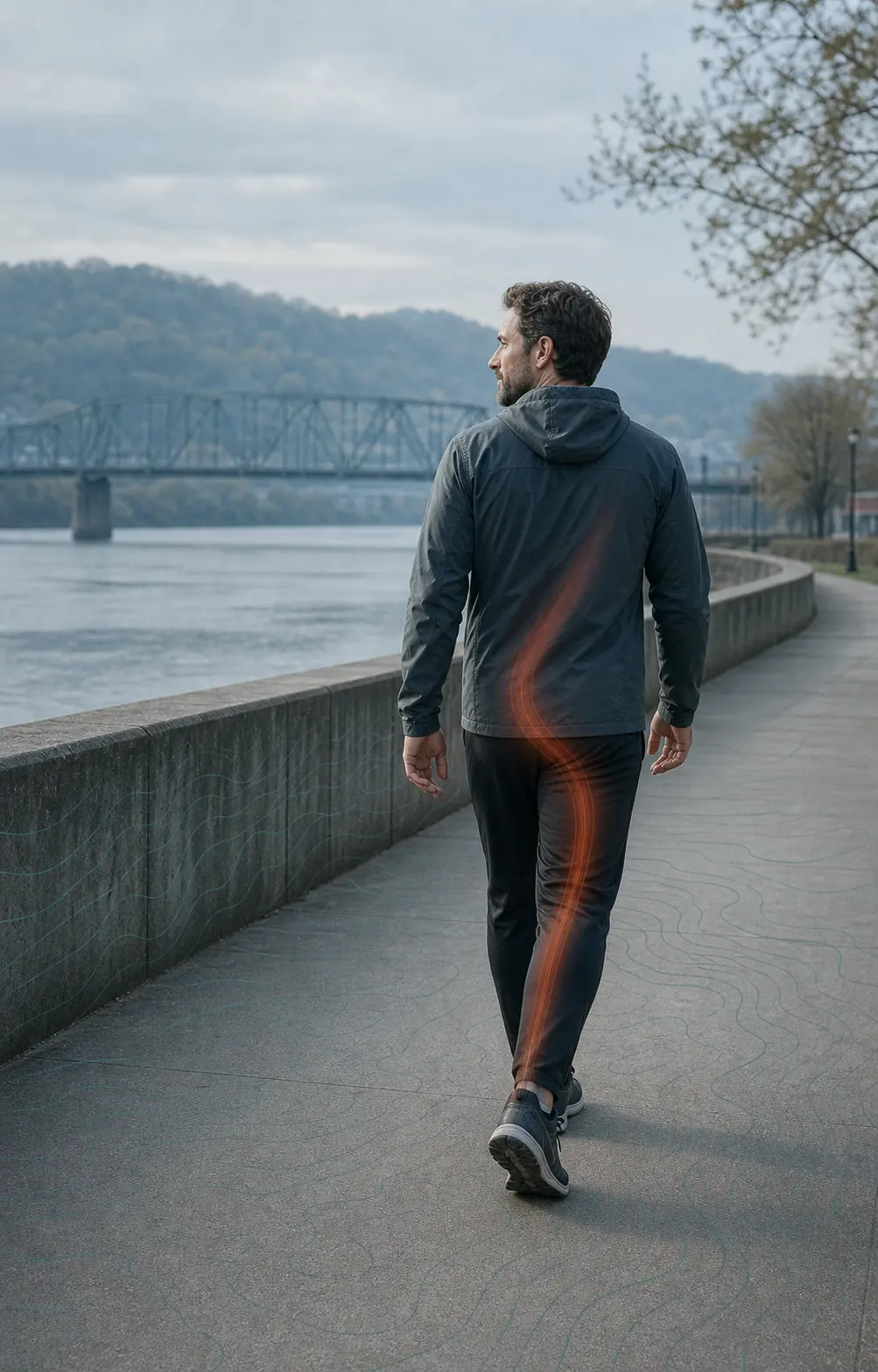
What should you write down about radiating leg symptoms?
Describe the route in words — where it starts and where it stops both matter.
- Does it begin in the centre of the back, one side, the buttock, or the thigh?
- Does it stop at the knee, continue into the calf, or reach the foot?
- Is it pain, tingling, numbness, weakness, temperature change, or a mixture?
- Is it constant, or linked to sitting, standing, walking, bending, coughing, or getting into a vehicle?
- Which side is affected?
- Did a knee, hip, or leg strike part of the vehicle?
- Was any similar pattern present before the crash?
Describe only the area that is actually involved. Precision is more useful than drama, and an evaluator can work with "outer calf into two toes" in a way they cannot work with "the whole leg."
Which leg symptoms require urgent care?
These findings can require medical evaluation, imaging, or treatment outside chiropractic scope. Do not wait for a routine appointment when the pattern is rapidly changing or unsafe.
Can sitting in the car make the symptoms more noticeable?
It can. Sitting combines hip position, low-back posture, and sustained pressure. A Portsmouth-area trip along US-52 or across a bridge approach can last longer than expected when traffic slows(opens in a new tab). That does not prove sitting caused the problem; it tells you the position may expose it.
Note how long you sat before the symptoms changed, and whether getting out and walking altered them. If driving feels unsafe because of weakness, numbness, medication, or limited control, do not drive.
The Portsmouth driving-position reset offers parking-lot setup checks. It is not an exercise plan and should not override clinical instructions.
What does a careful examination compare?
A focused evaluation may compare sides, gait, motion, strength, sensation, reflexes when appropriate, position tolerance, and movements that reproduce or relieve symptoms. It should review prior episodes and medical history.
The clinician should also look for a simpler explanation outside the low back. A sore knee from dashboard contact, a hip complaint, or a direct calf injury can change how you walk and muddy the picture.
If the findings call for medical referral or imaging, that should be said plainly. If the problem appears to fit conservative musculoskeletal care, the plan should define what will be measured at reassessment.
Is imaging always needed for sciatica after a crash?
No single rule fits everyone. Imaging decisions depend on the trauma, warning signs, neurological findings, history, symptom course, and the clinical question. X-rays are useful for some bone-related questions; MRI can show more soft-tissue detail(opens in a new tab). Neither replaces the history and examination.
"No imaging" should not mean "no evaluation." "Get every scan" is not a sound blanket rule either.
What can early progress look like?
Progress may be less dramatic than "the pain is gone." It could mean:
- The sensation no longer travels below the knee
- Sitting tolerance changes from ten minutes to twenty
- Walking becomes steadier
- Sleep is interrupted fewer times
- Getting out of the car takes one movement instead of three
Track the same task repeatedly. A different test every day produces noise, not a trend.
Questions about post-crash sciatica
Related guides
- Sciatica after a crashLearn how to describe leg pain, numbness, tingling, or weakness and which neurological symptoms need urgent medical care.
- Back painSee how the location, timing, and movement changes help describe back pain after a crash, along with symptoms that require urgent medical attention.
- The Portsmouth driving-position resetA non-rigid checklist for seat distance, mirror setup, position changes, and neck/back comfort on everyday drives around Portsmouth.
For care questions, start with car accident care after a collision or chiropractic care in Portsmouth for an everyday concern.
This page provides general information. It cannot diagnose an injury or replace emergency or medical care.