Delayed soreness after a car accident
Published by Portsmouth Accident & Injury Center.
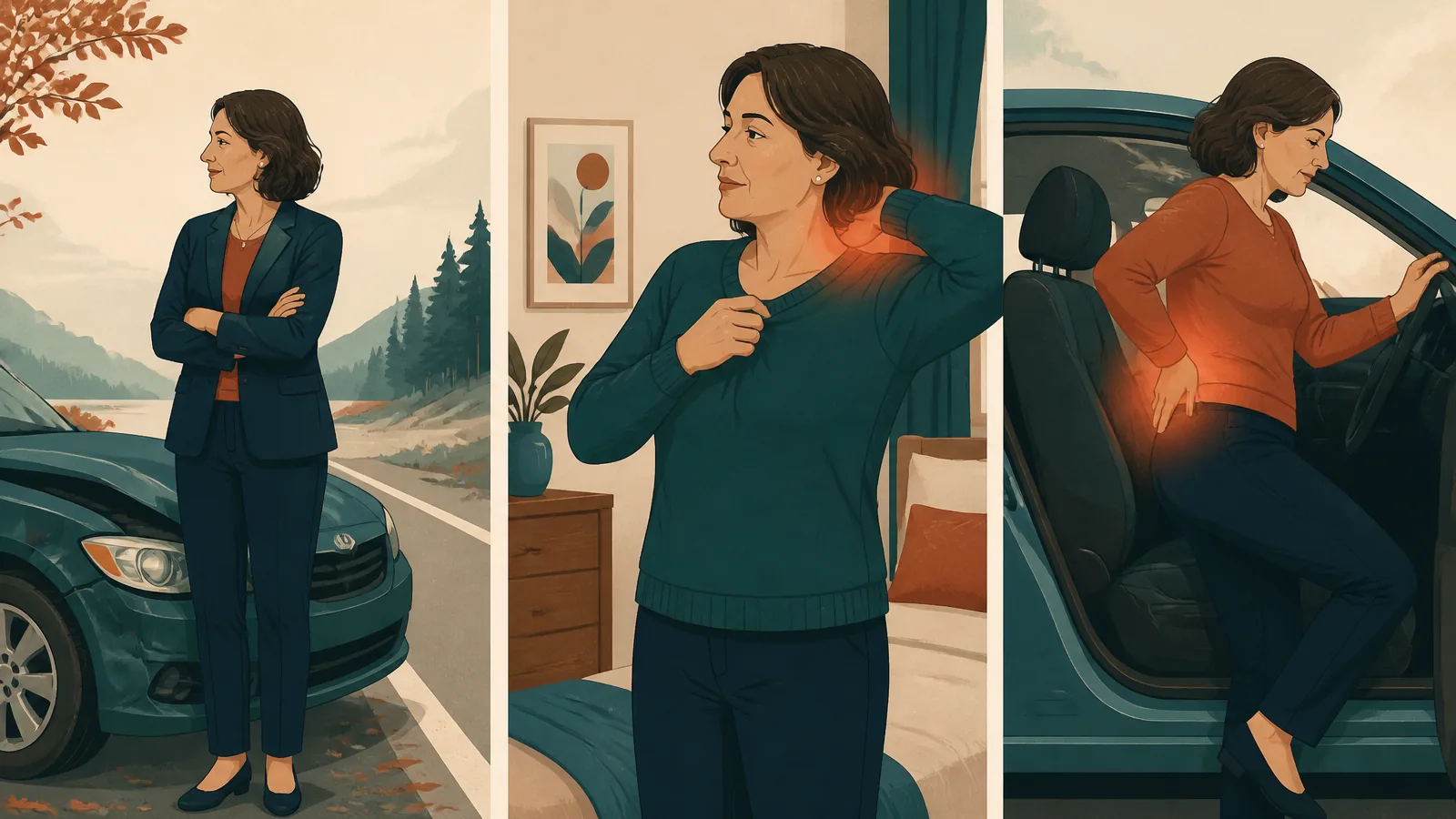
Why the scene is a bad measuring stick
People often summarize delayed soreness with one word: adrenaline. It is a tidy explanation, and it is incomplete.
At the crash scene, attention is divided:
- Traffic and safety.
- Other people in the vehicle.
- Talking with responders.
- Exchanging information.
- Tow and transportation logistics.
- Phone calls that cannot wait.
Then the situation changes. You sit differently. You drive differently. You sleep in an unusual position, or you barely sleep at all. You go back to lifting, working, or getting in and out of a vehicle. Movement patterns change, and symptoms may become easier to notice.
The useful takeaway is not a theory of biology. It is that “I felt fine at the scene” is a poor final answer.
Write the timeline while you still remember it
A clear timeline is more useful than a dramatic description. Keep it to four notes.
- What did you notice at the scene?
- What changed later that day or evening?
- What did you notice the next morning?
- What finally prompted the call or the visit?
Plain wording is best:
- “No neck complaint at the scene.”
- “Tightness started while driving home.”
- “Turning right was limited the next morning.”
- “No arm numbness.”
Notice what that timeline avoids. It does not name a diagnosis. It does not assign fault. It does not exaggerate. It gives a clinician something usable, and it protects you from accidentally overstating something you are not sure about.
Delayed does not mean safe to ignore
Some symptoms need urgent medical evaluation even when they appear later. That includes worsening confusion, repeated vomiting, a seizure, or a severe or worsening headache. It also includes weakness or numbness, trouble breathing, severe chest pain, or another emergency sign.
Concussion symptoms may appear later, and danger signs require emergency care. CDC concussion signs and symptoms(opens in a new tab).
Whiplash-associated neck symptoms may also develop after the event rather than immediately. MedlinePlus neck injury information(opens in a new tab).
Function tells a clearer story than a number
A pain score alone flattens the picture. Function shows the shape of the problem. Which task is different now? Turning your head to merge onto US-52? Getting out of a truck? Sitting through a full work shift? Sleeping through the night? Lifting a laundry basket?
“Pain 6 out of 10” means very little on its own. “I can drive, but I have to turn my shoulders to check the blind spot, and it is worse after an hour” is specific, checkable, and honest.
Timing alone does not prove cause
There is a temptation to argue that late-appearing pain proves the crash caused it, or that it proves the opposite. Neither claim is reliable on its own.
A clinician weighs several factors:
- Prior symptoms or prior injuries.
- Other events after the collision.
- Health history and medications.
- Examination findings.
- How the symptoms behave over time.
Being accurate is more valuable than sounding certain. If you do not remember whether something started Tuesday night or Wednesday morning, say that. An honest “I am not sure” is stronger than a confident guess that later falls apart.
Bring what you already have
If you received emergency instructions, urgent-care paperwork, imaging results, or medication instructions, bring them or mention them. A later visit is more useful when the provider knows what has already been checked, what was ruled out, and what has changed since.
The full delayed pain guide goes deeper, the whiplash guide covers the most common neck pattern, and what to do after a Portsmouth crash covers the practical first steps.
Related reading
Delayed pain
Build an accurate timeline of symptoms noticed after the crash scene and learn which delayed changes still require prompt medical care.
Read the guideWhiplash
Learn which symptoms may follow a rapid neck movement, which warning signs need medical care, and what an evaluation can clarify.
Read the guideThe first 72 hours after a Portsmouth crash
Follow a practical timeline for safety, reports, insurer calls, symptom notes, and decisions that can wait.
Read the articleConcussion warning signs
Review CDC concussion danger signs and learn why suspected concussion belongs with medical care, not chiropractic treatment.
Read the guide