What an X-ray can miss after a car accident—and what it still does well
Published by Portsmouth Accident & Injury Center.
X-rays are especially useful for questions about bones, fractures, and alignment. They do not show every muscle, ligament, disc, nerve, concussion, or other soft-tissue concern. A normal X-ray can be genuinely reassuring for the question it was ordered to answer without meaning "nothing happened." Further testing is not automatic; it depends on symptoms, examination findings, and medical judgement.
Two sentences can be true at the same time:
- "The X-ray did not show a fracture."
- "I still cannot comfortably turn my neck."
The first is not a dismissal. It is useful information. The second is not proof that the X-ray failed. It is a different question.
Understanding that difference can save a person from two bad conclusions: "Nothing is wrong because the image was normal," and "I need every advanced scan because I am sore."
What is an X-ray designed to show?
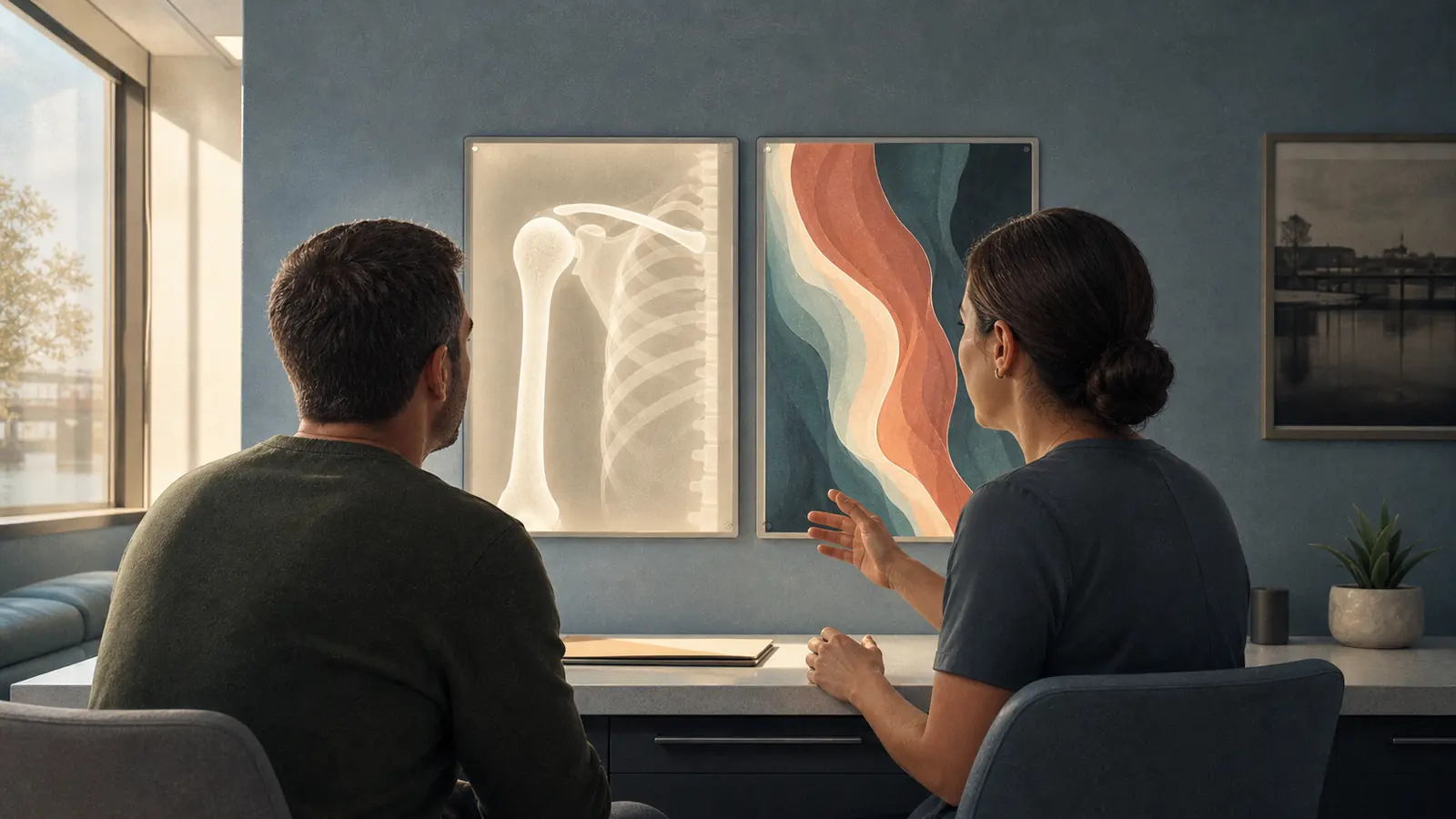
X-rays create images based largely on how tissues absorb radiation(opens in a new tab). Dense structures such as bones show up clearly, which makes X-rays useful for many fracture, dislocation, and alignment questions(opens in a new tab).
The clinician decides which body area and views are appropriate. The crash alone does not create a standing order for a whole-body series.
When a radiology report says there is no acute fracture, that is meaningful reassurance about an important concern. Keep the report and the instructions that came with it. Do not translate one sentence into a conclusion about every possible source of pain.
What does an X-ray not show well?
Standard X-rays provide limited detail for many soft tissues. Depending on the body area and the question, they may not directly show a muscle strain, ligament injury, disc problem, nerve irritation, concussion, or certain subtle injuries.
That does not mean one of those conditions must be present. It means the tool has boundaries. An X-ray answers the question it was ordered to answer, and a normal result is an answer — just not to every question you have.
Does ongoing pain mean you need an MRI?
Not automatically. MRI can show more detail in many soft tissues(opens in a new tab), including muscles, tendons, ligaments, joints, discs, and nerves. It also takes longer, costs more, has safety considerations, and may identify findings that are not responsible for the current symptom.
An imaging decision should follow a clinical question:
- Is there a neurological change?
- Did the examination identify a concern that imaging could clarify?
- Are there red flags or significant trauma findings?
- Is the symptom course changing the plan?
- Would the result alter management?
"I hurt, therefore MRI" is not enough. "The X-ray was normal, therefore no MRI could ever be useful" is not enough either.
Can imaging prove that a crash caused the finding?
Often, no. An image can show anatomy and abnormalities. It may not establish when a finding began or whether it is responsible for a specific symptom. Degenerative changes, old injuries, and findings without symptoms are common complications in interpretation.
The collision timeline, prior records, earlier symptoms, examination, and clinical reasoning all matter. Be wary of a provider who presents every imaging finding as proof of fresh crash damage. Be equally wary of one who dismisses a new functional change solely because an image shows an older condition.
What should happen after normal imaging but persistent symptoms?
Return to the clinical question. Tell the provider what has changed since the imaging:
- Which motion or task remains limited?
- Is the trend improving, stable, or worsening?
- Has pain started travelling?
- Is there new numbness, weakness, dizziness, or another symptom?
- Are sleep, work, walking, or driving affected?
- Were you able to follow the original instructions?
A car accident injury evaluation should connect imaging to the examination rather than treating the report as the whole patient. It should also identify concerns that need medical referral.
What are the urgent imaging-related warning signs?
Do not wait for a routine office to order a preferred test. Emergency departments decide what assessment and imaging are needed for emergencies.
How do you read a radiology report without panicking?
Start with the Impression section, but review it with the ordering clinician. Write down unfamiliar terms rather than searching each one in isolation. Ask:
- What important problem was the test looking for?
- What did the report find?
- Which finding, if any, fits my current symptoms?
- What does not fit?
- Does this change treatment, referral, or activity instructions?
- What change should make me call sooner?
Keep the original report in your one-folder crash record. Do not upload it through an unsecured public contact form.
What should a chiropractor say about imaging?
A chiropractor should explain scope, review relevant reports, and refer when the clinical question requires medical evaluation or imaging beyond that scope. The language should sound like: "This finding needs another opinion," or "The report answers the fracture question, but we still need to examine the movement complaint."
It should not sound like: "Everyone after a crash needs the same set of films," or "That tiny image finding proves why you hurt."
Use our questions before a chiropractic plan to ask how imaging will change decisions.
Questions about X-rays after a collision
Related guides
- Car accident careSee how the office evaluates non-emergency symptoms after a crash, documents findings, and decides when a medical referral is needed.
- Emergency department, medical visit, or chiropractor?Choose the right setting after a crash by urgency, symptoms, scope, and what each kind of visit is meant to answer.
- Nine questions to ask before a care plan beginsAsk about findings, goals, options, risks, reassessment, referrals, visit frequency, cost, and privacy before agreeing to care.
For care questions, start with car accident care after a collision or chiropractic care in Portsmouth for an everyday concern.
This page provides general information. It cannot diagnose an injury or replace emergency or medical care.